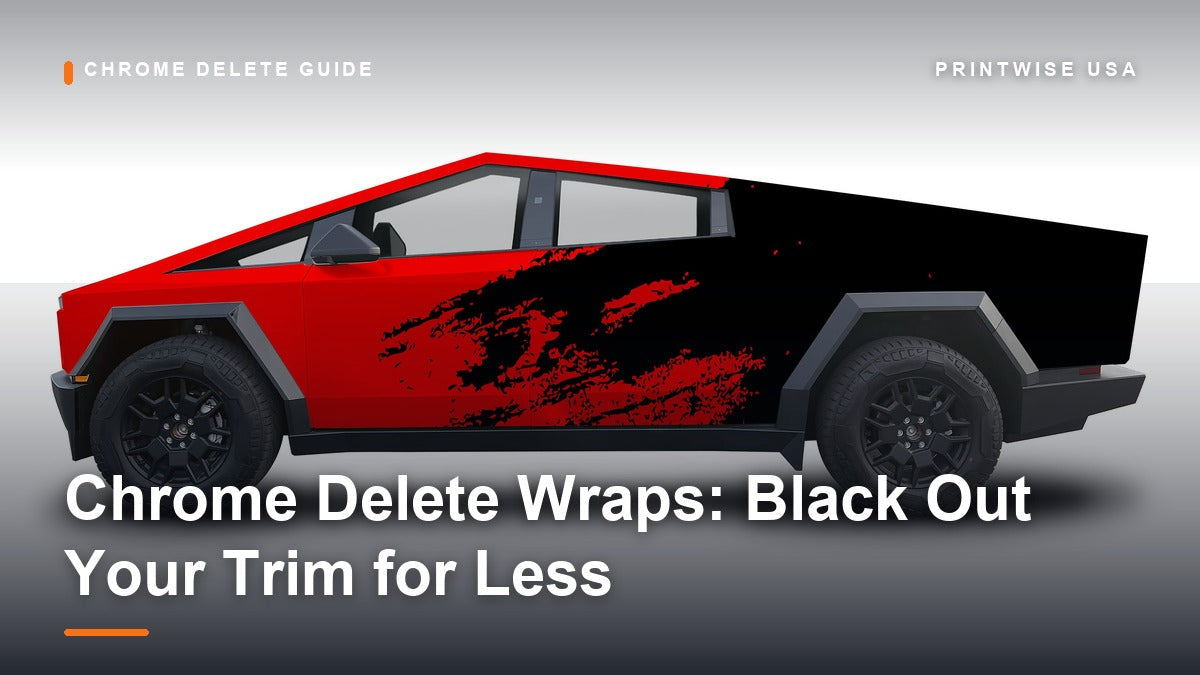
Chrome Delete Wraps: How to Black Out Your Vehicle's Trim for Less in 2026
Walk through any parking lot in the United States and one thing stands out: the sharpest-looking trucks, SUVs, and sedans almost always share a detail. Their window trim, grille surrounds, mirror caps, and badges are not bright chrome — they are blacked out. That single change, known across the aftermarket as a chrome delete, does more for a vehicle's stance than most performance upgrades, and it costs a fraction of what people assume. In 2026, vinyl wrap film has made chrome delete the most popular cosmetic modification for US vehicle owners from coast to coast.

Avery Dennison MPI 1105 Easy Apply RS cast vinyl film roll used for chrome delete and blackout trim work
What Is a Chrome Delete, Exactly?
A chrome delete covers a vehicle's factory chrome and polished metal accents with a dark film — usually gloss, satin, or matte black. The most common targets are:
- Window trim and beltline moldings — the strip along the base of every side window
- Grille surrounds and front fascia accents — the biggest visual payoff on trucks and SUVs
- Mirror caps and door handle accents
- Roof rails, pillar trim, and bumper inserts
- Emblems and badges, wrapped in place or removed and reinstalled
The result reads as a factory "blackout package" without the factory premium. On a mid-size SUV or half-ton pickup, a full chrome delete changes the entire personality of the vehicle for a few hundred dollars in material.
Why Vinyl Wins Over Paint and Dip
- Paint: Permanent, expensive, and hard to reverse at resale. Shops must scuff and prep the chrome, and any error is a repaint. It also destroys the finish underneath, which matters on a leased vehicle.
- Plasti Dip and spray films: Cheap to try, but they peel at edges, chalk in UV, and cannot survive automated car washes. On tight window trim they typically fail within a season.
- Cast vinyl wrap film: Removable, UV-stable, conformable around curves, and reversible in an afternoon. Quality cast film carries multi-year outdoor durability and peels off without damaging paint or chrome.
That reversibility is why chrome delete has exploded nationwide: it is the rare modification a leaseholder, a fleet manager, and a weekend enthusiast can all justify. The installation fundamentals are the same ones covered in our complete step-by-step vehicle wrapping guide.
The Right Film for Chrome: Cast, Not Calendared
Chrome trim is one of the most demanding surfaces on a vehicle. It is narrow, highly curved, and has compound bends around mirrors and pillars. That makes film choice non-negotiable.
You want a cast vinyl with pressure-sensitive, air-release adhesive. Cast film is poured on a liner rather than calendered, so it has no memory trying to snap back to a flat sheet. It stretches where you need it and stays put. Calendared film — the cheap sign-shop material — lifts and tents at every curve within weeks.
- Avery Dennison MPI 1105 Easy Apply RS — cast film with repositionable RS adhesive and air channels. Forgiving on narrow trim and around mirror caps, and the material most US wrap shops reach for on blackout packages.
- 3M IJ180MC-120 Metallic — the choice when the blackout is not plain black. Satin graphite and deep metallic charcoal catch light in ways solid color film cannot.
- Substance Ultracurve X1 High Tack with 10 mil lamination — built for aggressive curves like mirror caps and bumper corners, where standard adhesive wants to lift before it grabs.
Pro tip from the Printwise shop: order a swatch before committing. Gloss, satin, and matte black look completely different in daylight, and satin hides dust and fingerprints far better on a daily driver. A Printwise Sample Pack lets you hold each finish against your actual paint first.
What Chrome Delete Costs Across the USA in 2026
- Window trim only: roughly $150–$400 at a professional shop
- Window trim plus grille surround: $300–$700
- Full chrome delete (trim, grille, mirrors, handles, badges): $500–$1,200
- DIY with your own film: material cost only, typically well under $200
Compare that to a factory blackout package, which often adds $1,500 or more to a build sheet. For fleet owners the math gets better still: buy film in bulk, train one technician on trim work, and every new vehicle is blacked out for material cost. That is why buying wrap film direct has become standard practice for shops nationwide.

3M IJ180MC-120 metallic printable vinyl wrap film for satin and metallic black trim finishes
Can You DIY a Chrome Delete?
Yes — window trim is the best possible first project. It is flat, narrow, and forgiving. Plan for these realities:
- Cleanliness decides everything. Chrome holds oils and road film. Wipe with isopropyl alcohol, then wipe again. Any contamination becomes a visible bubble.
- Use heat sparingly. A heat gun at low setting relaxes film around curves. Too much heat stretches it thin and shortens its life.
- Knife-less tape is your friend. For tight gaps around badges and pillars, tape the edge and trim against it instead of dragging a blade near paint.
- Post-heat every edge. Edges not post-heated to roughly 90–95°C will lift in the first hot week. This is the most common DIY failure.
For squeegee angles, overlap strategy, and edge sealing, read our guide on vehicle wrap design and installation mistakes to avoid before you cut film.
Making It Survive American Weather
- UV exposure. In the Sun Belt — Arizona, Nevada, Texas, Florida — cheap film chalks within a year. Cast film with a UV-stable topcoat holds color five-plus years.
- Road salt and brine. In the Northeast and Midwest, winter brine works into lifted edges. Post-heated, sealed edges are what stop it.
- Automated car washes. Brush washes grab trim edges. Touchless washes and pH-neutral hand washing keep a chrome delete intact for years.
For work trucks that see real duty, consider adding protection over high-impact areas. A reflective graphic film is also worth considering on fleet vehicles, where night visibility is a safety requirement rather than a style choice.
Chrome Delete or Full Color Change?
Most owners start with a chrome delete and later move to a full wrap. The two work well together — blacked-out trim over a satin or matte body wrap produces the most modern look on the road in 2026. If you are weighing a full color change, our breakdown of color change vinyl wraps covers material options and long-term cost. And if your blackout includes printed accents, get artwork production-ready first: logo vectorization is the difference between crisp detail and a pixelated edge that looks amateur up close.
Start With a Sample, Finish With a Blackout
Chrome delete is the highest-return cosmetic upgrade available to US vehicle owners right now. It is reversible, affordable, and it makes almost any vehicle look like it left the factory with the sport package. The only real risk is choosing the wrong film.
Order a swatch set, pick your finish in daylight, and buy cast film with air-release adhesive. Whether you are blacking out a daily driver in Ohio, a show truck in Texas, or an entire service fleet running routes across the United States, the material is the same — and it is the part worth getting right.
Ready to start? Browse the full Printwise USA wrap film collection or reach out to our team for help matching a blackout finish to your paint color.